.boo domain—not just for Halloween. See how you can use it
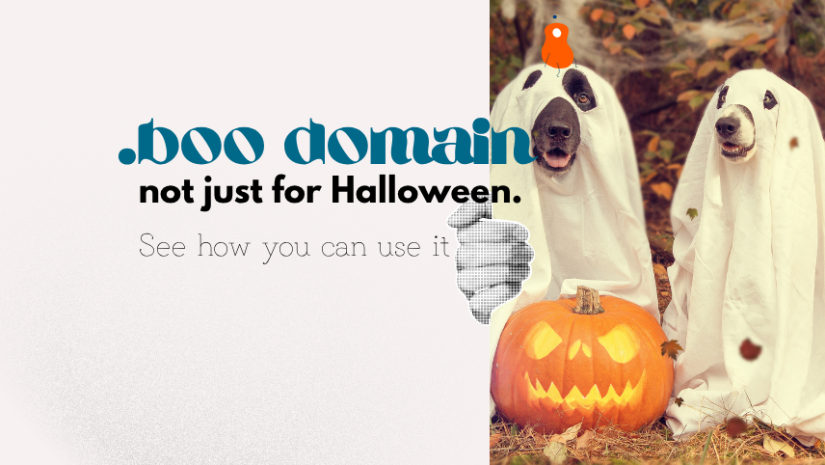
The word “boo” or “boh” is over 500 years old and likely originates from Greek.
In ancient times, the word meant loud crying, roaring, or screaming. Historians and linguists have noted an increased interest in the word “boo” during the eighteenth century. The Scottish author Gilbert Crokatt is credited with popularizing the word in his volume *Scotch Presbyterian Eloquence Display’d*. In the early 20th century, the exclamation “boo” was attributed to ghosts and remains associated with them to this day.
What makes the word “boo” so effective at scaring someone? It’s likely that the sounds contained in the letter “b” and the ability to pronounce “oo” loudly make “boo” an exceptionally terrifying sound. Linguists suggest that “boo” is a monosyllable, which means we can say it very quickly—and this also increases the chances of scaring someone around us. As you can see, the “Boo!” associated with ghosts literally means that ghosts are shouting to scare us.
.boo, I love you!
In English, “Boo” is a term of endearment meaning “Darling.” Therefore, the .boo domain should appeal not only to those running Halloween-related businesses or activities, but also to those who’d like to express their feelings—especially toward their loved one—for example, by registering domains like hey.boo or youremy.boo. Cute, isn’t it?
.boo is very cute—a domain for lovers of miniature Spitz dogs
There’s one more angle to explore with this spooky term, and it lies on the opposite end of its meaning. Boo the dog became famous in October 2010 when American singer Kesha joked on Twitter that she now had a new boyfriend and posted a link to the adorable pup’s Facebook fan page. The owner of the little miniature spitz was Irene Ahn, a Facebook employee. The dog won the hearts of millions of people around the world, and by 2020, Boo had amassed 16 million likes. Boo’s popularity led to the publication of two books about him:
- *The Life of the World’s Cutest Dog*,
- *Little Dog in the Big City*.
These were accompanied by a calendar, as well as cut-outs and children’s books. His adorable appearance made millions of people around the world want a dog just like him. Thanks to him, the Pomeranian breed became very popular, and everyone associated the name “Boo” with the Miniature Spitz breed. For this reason, the .boo domain should also be of interest to breeders of these dogs. In addition to the .boo domain, which will be available soon, at Domeny.tv you’ll also find the .dog domain dedicated to dog owners.
Since there are very few domains strictly related to animals, we’d also like to suggest another extension dedicated to our pets:
- the .pet domain, which will meet the needs not only of pet owners but also of everyone involved in the pet industry—including pet stores (both brick-and-mortar and online) and veterinary clinics.
There aren’t many domains dedicated to pets, so it’s worth securing the names you’re interested in as soon as possible. This way, you’ll be sure that the most attractive names will be registered by you!
Watch out, .boo—you’ll be booed!
In English, the word “boo” means a whistle or to be booed, which is clearly associated with disapproval. In this context, a .boo domain could help you launch a completely new venture related to a website featuring memes or funny videos. On the other hand, the .boo domain could be a step toward websites that highlight global issues deserving widespread condemnation.
The .boo domain!
As you can see, there are many ways to use the .boo domain. The .boo domain is designed to create a space for creative people and isn’t limited to topics related to emotions. We hope you’ll find a use for the .boo domain in your online activities. You can register a domain not only related to Halloween but also to breeding Pomeranian dogs. Perhaps you offer products with “boo” in their names—in that case, it’s also worth considering registering a .boo domain.
Former Head of Customer Support with extensive experience in client relations and e-commerce. She combined her daily work with writing about customer experience and online business, while exploring how AI can transform both fields.
Categories
Similar and recommended posts
Recent posts




Recently popular posts