How can a domain extension affect a website’s credibility? Top-Level Domains and user trust
The domain extension is one of the first things visitors see when they come to your website. Before they even read a single sentence, their brain has already assessed whether the URL looks credible. Choosing the right TLD (Top-Level Domain) extension influences user trust, click-through rates in search results, and can indirectly impact conversion. In this article, you’ll find specific criteria to help you match your domain extension to your target audience and business goals.
What is a top-level domain, and why is it so important?
A top-level domain is the last part of a web address—the segment following the final dot in the URL. When someone types amazon.com or wikipedia.org into a browser, .com and .org serve as the TLD. Although this domain extension consists of only a few characters, it conveys a specific message about the nature of the website.
Top-level domains
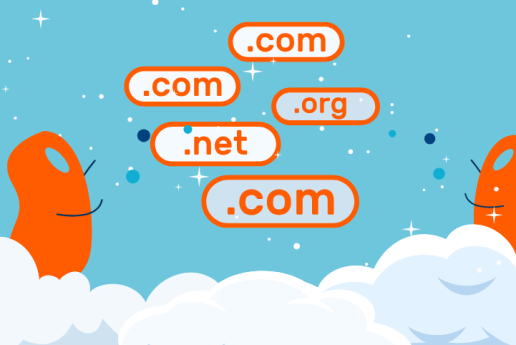
TLDs are divided into several main categories. Generic domains (gTLDs — Generic Top-Level Domains) are extensions such as .com, .net, or .org, which are not assigned to any specific country and do not contain a geographical designation. They are also called global domains. They were originally intended for specific types of organizations: .com for commercial entities, .org for non-profit organizations, and .net for technology companies. Today, registration is open to everyone.
Country-code top-level domains (ccTLDs)
ccTLDS are assigned to a specific country: for example, .pl for Poland, .de for Germany, and .fr for France.
Sponsored Top-Level Domain (sTLD)
In turn, so-called sponsored domains (sTLD — Sponsored Top-Level Domain) are subject to restrictions — .edu is reserved for educational institutions, .gov for government institutions, and .aero for entities in the aviation industry.
Since 2012, the Internet Corporation for Assigned Names and Numbers (ICANN) has opened registration for new extensions (ngTLDs), such as .shop, .blog, .app, and .tech. Currently, there are over 1,500 different domain extensions on the market.
Such diversity offers enormous opportunities, but at the same time complicates the choice of a domain because not every extension inspires the same level of trust among users.
Why is this the case? A domain name is part of a brand’s identity, just like a company name or logo. Many domains with various extensions are registered and then used in the “gray area,” including for cybercrimes. Domain registries and registrars are not always able to detect all cases of abuse quickly enough.
For example, according to a report by The Spamhaus Project covering April–September 2024, as many as 1.8 million domains were flagged as malicious or suspicious. Significantly, in six gTLDs, over 25% of all domains were listed in registries with a poor reputation: .pink (48.96%), .loans (41.62%), .loan (39.23%), .rest (36.91%), .ooo (27.45%), and .photo (27.40%).
For a user, the end of a URL can be one of the first indicators of whether interacting with a given domain is safe—even before the page content loads.
A store with a domain extension associated with a good reputation, such as .pl, .com, or .org, starts from a position of trust.
Global and country-code domains — which extensions build user trust
We’ve written about how to choose a domain extension on our blog; it’s worth reading the article: A profitable choice of domain extension: how a domain extension works to Boost Sales. After reading it, you will be able to choose a domain extension tailored to your business needs.
User trust in a website starts with the URL. Popular extensions, such as .com, .pl, or .org, inspire greater trust, and this is no coincidence. These extensions have been in use on the internet for decades, and users have grown accustomed to them just as they would to familiar brands on a store shelf. Less recognizable domain extensions can come across like an unlabeled product—it may be of excellent quality, but it inspires caution and a desire to verify its authenticity.
Global domains are extensions available to everyone, regardless of location. The most recognizable gTLD remains .com—according to data from Verisign, over 160 million domains have been registered with this extension worldwide. Domains ending in .com are considered more professional and inspire greater trust among users, especially in an international context. If your company targets customers from different countries, this domain extension is the best choice.
The .org extension is associated with non-profit organizations and institutions operating in the public interest, which lends it an aura of credibility, though commercial entities are increasingly adopting it as well. Meanwhile, .net, originally intended for companies in the technology sector, now serves as a fairly solid alternative to .com when the preferred domain name is already taken.
Country-code domains serve a completely different function. Their strength lies in local trust. For example, for Spanish users, the .es extension is perceived as more credible than so-called exotic extensions. An address ending in .es signals that the company operates on the Polish market, understands local realities, and is subject to Polish legal regulations. Country-code domains can increase user trust in a given region and translate into a higher click-through rate in search results.
It is worth noting a significant difference between generic and country-code domains in terms of the target audience. A company operating an online store exclusively on the French market will benefit more from a .fr domain than from a .com domain. A customer from Paris or Lyon subconsciously perceives a website ending in .fr as “their own”—closer, more accessible, and above all, safer in terms of complaints and consumer protection. On the other hand, a tech startup with global ambitions may consciously choose .com or the industry-specific .tech to communicate the international nature of its business from the very first contact.
Some TLDs, such as .gov and .edu, are considered more secure than others, which can influence user decisions. This is a result of restrictive registration rules—sponsored domains (sTLDs) available exclusively to government institutions or educational institutions carry a guarantee of authenticity that cannot be bought for a few dozen zlotys a year.
How a domain extension affects click-through rates and website ranking
Choosing the right TLD affects a website’s visibility in search results—but not in the way most guides intuitively suggest. Google officially confirms that the type of top-level domain itself is not a direct ranking factor. John Mueller, Search Advocate at Google, has repeatedly pointed out that the algorithm does not favor .com over .net or .org over .shop. A website’s ranking depends on content quality, backlink profile, page load speed, and dozens of other technical signals. Nevertheless, the domain extension influences rankings indirectly, and these indirect mechanisms have a real impact on traffic.
The first of these is the click-through rate (CTR) in search results. The user sees ten results in the list, and next to each title, a URL with a domain extension. A website with the .pl or .com extension in Polish Google results inspires greater trust; these are highly recognizable extensions that users are accustomed to. A page with a more exotic extension, such as .xyz, .click, or .top, may be overlooked, even if it ranks higher. Google officially denies that CTR is a direct ranking factor. Gary Illyes, mentioned earlier, stated outright that theories about CTR’s impact on rankings are “made-up crap.” Nevertheless, greater trust in the local market translates to a higher CTR. This simply means more visits, more potential conversions, and a better chance of earning backlinks—and backlinks are a confirmed ranking factor.
The second mechanism concerns country-code domains and geotargeting. Domains with geographic extensions (ccTLDs, e.g., .de, .cz) signal to search engines that the content is targeted at users from a specific country, which can positively impact local search results. For a company operating, for example, in the Slovak market, the .sk domain is one of the strongest localization signals, stronger than settings in Google Search Console or the hreflang attribute. The search engine interprets such a domain as an unambiguous declaration: “this site is for Slovak users.” The result? Better rankings in search results for queries from Slovak IP addresses.
The third aspect is email deliverability and domain reputation. The bad reputation of certain TLDs can result in them being blocked by spam filters.
The bad reputation of certain TLDs can result in them being blocked by spam filters. Reports from The Spamhaus Project consistently list extensions such as .top, .loan, and .bond among the TLDs with the highest percentage of domains with a poor reputation—in the case of .loan, as many as 39.23% of all active domains in the zone file were listed by Spamhaus as malicious or suspicious.
If your company uses a domain with a tarnished reputation, messages may end up in the spam folder, no matter how carefully you configure SPF, DKIM, and DMARC. This, in turn, weakens communication with customers and undermines the brand’s professional image.
New TLDs, such as .shop, .blog, or .tech, can be beneficial from a marketing perspective, but they do not, in and of themselves, provide a direct SEO advantage. Their value lies elsewhere, in branding communication. The address mybook.blog tells the user exactly what to expect before they even click the link. If you want stable website rankings in a competitive industry, a proven extension remains the safer foundation: .com for global reach and the appropriate country-code top-level domain (ccTLD) for sales in different countries.
New domain extensions — opportunity or risk for online stores
Since 2012, several hundred new domain extensions (ngTLDs) were intended to revolutionize the way web addresses are built. Extensions such as .shop, .store, .online, and .app promised a precise match to the industry and made it easier to find an available domain name. For online store owners, this sounded promising: instead of fighting for a taken .com name, they could immediately register markaodziez.shop and clearly communicate their business profile. Did this promise hold up in practice? These are not very popular domain extensions in Poland, as is also evident in our website’s sales statistics.
The main advantage of the new extensions is their availability and clarity. With popular extensions, finding an available domain can be a challenge. In that case, rebranding your name is the next step.
If you want to stick with your current name, you can choose from over 1,100 extensions. For example, for an online store, the selection is much wider in extensions like .shop or .store. A domain with the right extension can attract more customers and improve your brand image, especially if the extension immediately suggests the nature of your business. The address ecofood.shop requires no further explanation; the user knows they’re heading to an online store before they even see the page.
The problem arises on the other side of the equation: on the trust side. Some cheap or exotic extensions may be associated with spammers, which increases users’ concerns. Extensions such as .top, .xyz, or .click have gained a bad reputation not because of the technology itself, but because domains used for phishing and sending spam were registered en masse under them. For the average online store customer—someone who is about to enter their credit card number—the difference between sklep-premium.com and sklep-premium.top is not neutral. The first version looks more professional, while the second may raise more doubts due to the extension’s lower popularity.
A practical strategy for an online store owner therefore looks like this: the main domain in a proven extension (.pl or .com), and new TLDs as a marketing tool for specific promotional campaigns. You can register the domain yourbrand.shop and redirect it to the homepage or a dedicated sale subpage. The cost of registering an additional domain is minimal compared to the potential risk of losing conversions if the store’s main address sounds unfamiliar.
How to choose a domain tailored to your target audience?
Choosing a domain is a decision you make once, and its consequences are felt for years. Changing the TLD after registering a domain is possible, but it requires creating a new URL and transferring content, which carries the risk of losing search engine rankings and confusing existing customers.
The first step is to precisely define your target audience. Who are your customers? Where do they live? In what language do they search for information?
The second step is to analyze the industry and the competitive landscape. Check which extensions your direct competitors are using. If five out of seven leaders in your niche operate on .pl, and you choose .net.pl or .com.pl (once a very popular extension), users may subconsciously perceive your site as less established. It’s not a matter of technology but of perception. Of course, the rule works the other way around as well: in the tech or startup industry, a domain like .io or .tech can signal innovation and set you apart from competitors using classic extensions.
The third step concerns the domain name itself. Even the best extension won’t save an unreadable or overly long address. The URL should be short (preferably up to 15 characters without the extension), easy to pronounce over the phone, and unambiguous in spelling. Avoid hyphens, numbers in the middle of words, and names that can easily be confused with competitors. Your company’s domain is its web address in the literal sense of the word; customers need to remember it after just one interaction.
Step Four — Consider registering your domain with multiple extensions at once. This is a common practice among companies that prioritize brand protection and consistent communication. Your main website address can be on .pl, but it’s also worth securing, for example, .com and any industry-specific or country-specific variants if you plan to enter other markets. The costs of maintaining a domain in additional extensions are low (usually a few to several dozen zlotys per year for each), and the benefits are tangible: no one will hijack your company’s name in another TLD and use it to build a competing website or phishing-related pages.
It’s also worth paying attention to the .eu extension, especially if your company operates within the European Union. The .eu extension falls between the local european extension and the global .com, signaling a European reach without losing regional context. For export-oriented or service-based companies operating across borders, this is a sensible compromise.
When choosing a domain, start by checking the availability of your chosen name across several extensions at once. On the Let's Domains website, you can enter a single keyword and immediately see which variants—from .pl through .com to .shop, .org, or .net—are available and at what price. This is the easiest way to make an informed decision without having to search through multiple websites.
Domain registration step by step — from checking availability to maintaining the domain
Registering a domain with your chosen TLD is quick and easy, and you can start the process with a reputable domain registrar. On the Let's Domains website, the entire process—from searching for an available name to confirming your order—takes just a few minutes. Below, you’ll find the individual steps you’ll go through during registration.
Step 1: Searching for and checking the availability of a domain name. To register a domain, you must first check its availability on the registrar’s website. There is a search engine on the Let's Domains homepage. Simply enter your chosen name along with the extension and click the “Search” button.
Step 2: Select extensions and add to cart. After confirming your search, you’ll see a list of available and taken domains. Select the ones you’re interested in and add them to your cart. You can register a domain across multiple extensions at once—this is a sensible strategy for brand protection.
Step 3: Log in or create an account. After proceeding to the order summary, you will be asked to log in. If you don’t have an account on Let's Domains yet, you can create one in just a few minutes—simply provide your personal information (required for domain registration in accordance with registry requirements), review the terms of service and privacy policy, and then accept the terms. Registered users regularly receive discount codes for selected domains, which can be entered during the summary stage.
Step 4: DNS configuration and payment. Before finalizing your order, you can enter the DNS server addresses of your hosting provider or leave the default settings (you can change them later at any time from the customer panel). If you are registering a domain on behalf of another entity—e.g., as an intermediary—use the “Add new identity” option. Several payment methods are available: bank transfer, quick online payments, credit card, prepaid balance and e-wallets . Once the payment is processed, Let's Domains begins the registration process, and an order confirmation is sent to the account owner’s email address.
Step 5: Renewal and long-term domain maintenance. Once a domain is registered, it must be renewed regularly. The standard subscription period is one year, though many registrars allow you to pay for a longer period in advance. A longer registration period eliminates the risk of accidental expiration of the web address, which could result in losing the domain and having to rebuild your position in search results. Set up automatic renewal or a reminder at least 30 days before the expiration date—this is the simplest way to protect against a costly oversight.
Summary
Choosing the right TLD is a decision that affects user trust, click-through rates in search results, and long-term brand recognition. Popular extensions like .com and .pl build credibility, country-code domains strengthen local SEO, and new industry-specific extensions work well as a marketing tool, provided they are chosen thoughtfully. It is crucial to match the domain extension to your target audience and the specifics of the market in which you operate. Whether you’re taking your first steps online or planning to rebrand an existing website, start by checking the availability of your chosen domain name on Let's Domains and compare your options before making a final decision.
FAQ
Here you will find a few questions with answers tied to this topic.
How do global domains differ from country-code domains?
Global domains (gTLDs), such as .com, .net, or .org, are not assigned to any specific country and are suitable for international projects. Country-code domains (ccTLDs)—e.g., .pl for Poland, .de for Germany—indicate the website’s geographic affiliation. For Polish users, the .pl extension is perceived as more credible than exotic extensions because it is associated with a company operating locally and subject to Polish regulations.
Does the domain extension affect a website’s ranking on Google?
The type of top-level domain itself is not a direct ranking factor; Google has officially confirmed this. However, the domain extension does have an indirect impact: country-code domains send a strong geotargeting signal, and recognizable extensions can increase the click-through rate in search results, which over time translates to better rankings.
Which TLDs inspire the most trust among users?
Popular extensions, such as .com, .pl, or .org, build trust. Sponsored domains like .gov and .edu are considered the most credible due to their restrictive registration policies. Some cheap or exotic extensions (.top, .xyz, .click) may raise caution because they are associated with spammers.
Is it worth registering a domain with multiple extensions at the same time?
Yes—it’s a common brand protection practice. The main website address can operate, for example, on .pl, while additional registrations under .com, .eu, or industry-specific extensions protect against competitors or phishing sites taking over the name. The costs of maintaining a domain in additional extensions are minimal compared to potential losses.
Which domain extension should you choose for an online store?
For online stores operating in the Polish market, the safest choice is .pl or .com. New extensions like .shop or .store can serve a supplementary function, e.g., as a campaign address or landing page—but the main domain should be based on an extension that inspires customer trust, especially for transactions requiring payment information.
Can changing the TLD harm my website?
Changing the TLD after registering a domain is possible, but it requires creating a new URL and migrating the content. In practice, this means setting up 301 redirects, notifying search engines, and rebuilding your backlink profile. Your website’s search rankings may temporarily drop, so it’s best to make the decision to change the extension once and for all.
What are sponsored domains (sTLDs) and why do they inspire trust?
Sponsored domains are extensions managed by specific organizations, with strict registration rules. The .edu extension is reserved exclusively for educational institutions, .gov for government agencies, and .aero for entities in the aviation industry. This limited access means users automatically associate these extensions with a higher level of credibility.
How can you check if a domain name is available?
On the Let's Domains website, simply enter the name you’ve chosen into the search bar on the homepage, and the system will check its availability across multiple extensions simultaneously—from .pl and .com to industry-specific extensions like .shop or .tech. The entire process takes just a few seconds.
Former Head of Customer Support with extensive experience in client relations and e-commerce. She combined her daily work with writing about customer experience and online business, while exploring how AI can transform both fields.
Categories
Similar and recommended posts


Recent posts

Recently popular posts